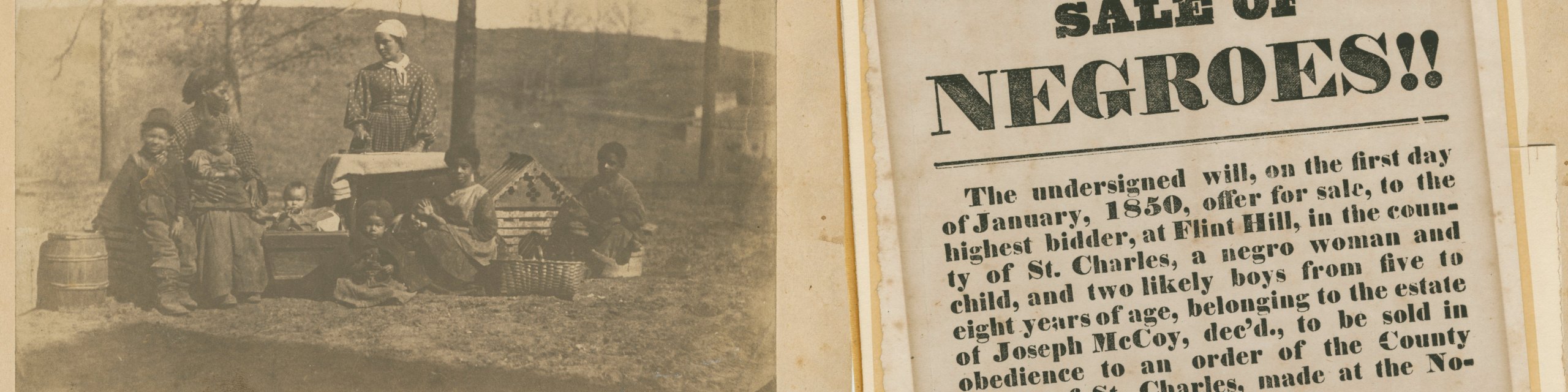
The commodification of Black birth
In 1655, Elizabeth Key sued for her freedom. Her father was English, and her mother was an enslaved African woman. Under the English legal rule the colonies had inherited, a child's status followed the father. Key argued that she had been held in slavery unlawfully. After an appeal that reached Virginia's General Assembly, she won.
Six years later, Virginia changed the rule. A child's status would now follow the mother. If the mother was enslaved, the child would be enslaved too, no matter who the father was. The wording was brief. The effect was enormous.
Exhibit · Document
The law itself, in full
Seventy-one words. This is the entire act.
Virginia General Assembly · December 1662 · Act XII
Negro womens children to serve according to the condition of the mother
WHEREAS some doubts have arrisen whether children got by any Englishman upon a negro woman should be slave or ffree, Be it therefore enacted and declared by this present grand assembly, that all children borne in this country shalbe held bond or free only according to the condition of the mother, And that if any christian shall committ ffornication with a negro man or woman, hee or shee soe offending shall pay double the ffines imposed by the former act.
Transcribed from William Waller Hening, ed., The Statutes at Large; Being a Collection of All the Laws of Virginia from the First Session of the Legislature, in the Year 1619 (New York: R. & W. & G. Bartow, 1823), 2:170. Spelling is the original.
Source · Act XII, Virginia General Assembly, December 1662, in William Waller Hening, The Statutes at Large, vol. 2, p. 170. Spelling and punctuation as in the original.
Black people were already being actively dehumanized, bought, and sold as property when this rule was established. They appeared in estate records and newspaper sales posts beside land, furniture, and livestock. The new law expanded the reach of that thinking by answering a very specific question: what would happen when a white man fathered a child with an enslaved woman? Under the old rule, that child might have a claim to freedom. Under the new one, the child became property at birth.
The rule later became known as partus sequitur ventrem — the child follows the womb. It made slavery pass through the mother and removed the father from the legal picture. A white man could father a child with an enslaved woman and gain wealth from that child without taking on a legal duty to either of them.
Enslaved women created value through the work they were forced to do in fields, homes, shops, and businesses. Their ability to have children created value too. Each birth could add another person to an enslaver's estate without the cost of buying someone. The control of Black women's bodies was built into how slavery grew.
The law also punished sex between white and Black people while protecting the money made from children born through the abuse of enslaved women. That may sound like a contradiction, but it becomes clearer when we look at what the law was meant to protect. It was not meant to protect Black women. It was meant to protect slavery.

Broadside advertising the sale of William Bland’s property at Elizabethtown, Kentucky, 19 February 1847. Three men, four women, one boy and “some children” are listed between the horses and the cattle. Collection of the Smithsonian National Museum of African American History and Culture · Object 2011.155.292 · No known copyright restrictions
This is why the legal history of slavery belongs in a reproductive health curriculum. Medical experiments later carried out on enslaved women depended on the fact that their refusal had no force under the law. The wealth discussed in the next chapters grew in part because slavery could add more enslaved people through birth. The policing of Black mothers and the removal of Black children also have roots in a system that gave other people legal control over Black family life.
Slavery was a system of labor and money, but it also crossed over into essentially every single layer of life. So yes — it was inevitably also a system built around control over pregnancy, birth, the physical health of women who could have babies, and the babies themselves. Ending legal slavery ended legal ownership. It did not undo all of the ideas, rules, and habits that had grown around that control.
Get new chapters and updates →
Sources 6 entries
- Act XII, Virginia General Assembly, December 1662: “all children borne in this country shalbe held bond or free only according to the condition of the mother.” In William Waller Hening, The Statutes at Large; Being a Collection of All the Laws of Virginia, vol. II (1823) — the compilation in which the Latin was first attached to the act.
- Morgan, Jennifer L. “Partus Sequitur Ventrem: Law, Race, and Reproduction in Colonial Slavery.” Small Axe 22, no. 1 (March 2018): 1–17.
- Morgan, Jennifer L. Reckoning with Slavery: Gender, Kinship, and Capitalism in the Early Black Atlantic. Duke University Press, 2021.
- Roberts, Dorothy. Killing the Black Body: Race, Reproduction, and the Meaning of Liberty. Vintage Books, 1997.
- Broadside: Collection of the Smithsonian National Museum of African American History and Culture, object 2011.155.292. No known copyright restrictions.
- Virginia General Assembly. “Negro womens children to serve according to the condition of the mother,” Act XII, December 1662. In William Waller Hening, ed., The Statutes at Large (New York: R. & W. & G. Bartow, 1823), 2:170.