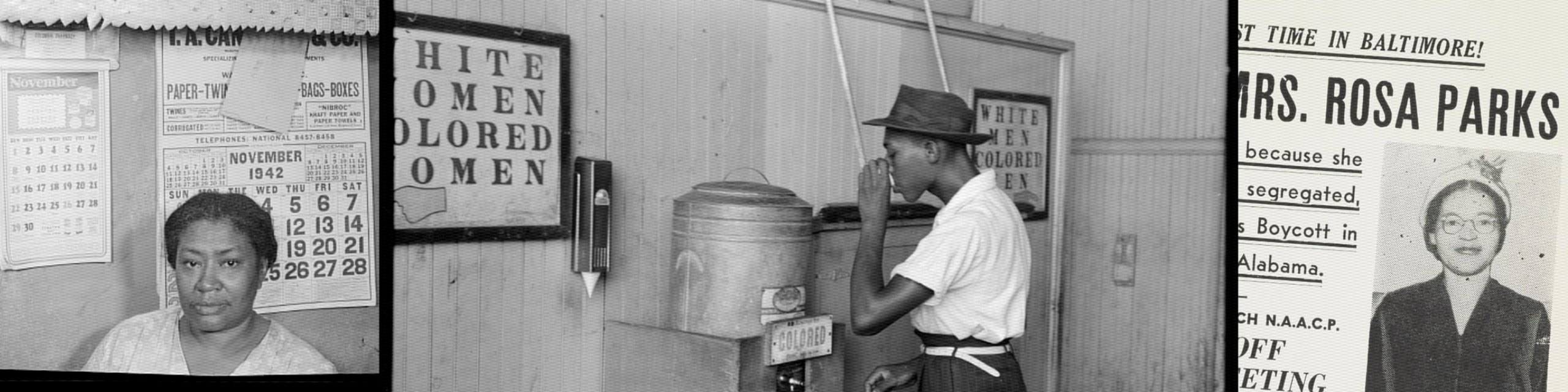
How long slavery and discrimination lasted
A common response to this history is, "That was a long time ago." At face value, that is true. The Virginia law from the last chapter — the one that made the children of enslaved Black women enslaved as well — was passed in 1662. The Thirteenth Amendment, which ended legal slavery, wasn't ratified until 1865.
But when we stop counting years and start counting families, that distance doesn't feel nearly as large. The people who were born under that 1662 law are only about 12 generations removed from us. The people who experienced the end of legal slavery are only about five or six generations back for many Black Americans today.
Emancipation — being freed from slavery — did not create a fresh start for people who had been enslaved. During Reconstruction, many Black Americans did begin to vote, hold office, build schools, buy land, and take a larger part in public life. But that change lasted only a little more than a decade. The ideas the country had created about Black people — who they were and what position they were supposed to hold — were in direct conflict with the new reality unfolding. As federal protection faded, people who wanted to keep the old balance of power built new rules around Black work, movement, voting, property, and family life.
Black Codes made ordinary parts of life a crime when Black people did them. In some places, being unemployed or unable to prove that you had a labor contract could lead to arrest under vagrancy laws. Convict leasing then sent many people back into forced labor. Poll taxes and literacy tests blocked voting. Racial terror enforced the rules outside of court. Redlining and exclusion from major federal programs later blocked many Black families from homeownership and other ways of building wealth. These things did not happen one at a time. They overlapped, and each one made the next harder to escape.
It is often easy for us to see and celebrate how something positive passed down through a family can create something beautiful today — like a great-grandmother's home being cared for by each generation and renovated into a home her family can still use. So it stands to reason that the opposite is true too. What is lost or denied may not completely decide what is possible for the generations that follow, but it can still ripple forward in a meaningful way.
Exhibit · Timeline
Three chapters, drawn to length
Twenty-five milestones, spaced by their real distance in time.
Three chapters, drawn to their true length. Tap any chapter or marker to go deeper.
The 25 milestones
1619First enslaved Africans arrive
The first documented enslaved Africans are brought to Jamestown, Virginia, beginning the transatlantic slave trade in the British colonies.
1662“Condition of the mother” law
Virginia enacts partus sequitur ventrem: a child's enslaved or free status follows the mother's, not the father's. It makes Black women's reproduction the engine of hereditary slavery — the legal root of centuries of reproductive control.
1676Bacon's Rebellion
An uprising of both poor white and enslaved people in Virginia alarms the colonial elite. The backlash further hardens the conditions of racial slavery and strategies to drive wedges between poor whites from the enslaved.
1739Stono Rebellion
One of the largest slave uprisings in the British colonies. Enslaved people near the Stono River in South Carolina rose up to fight for freedom; the revolt was defeated, and harsher slave codes followed.
1787Three-Fifths Compromise
The Constitution counts each enslaved person as three-fifths of a person for representation and taxation — this boosts slaveholding states’ power while continuing to deny enslaved people any voice of their own. Foundational political dehumanization.
1808Atlantic slave trade banned
Congress bans the importation of enslaved people. But the domestic slave trade and coerced reproduction intensify to meet the demand for unpaid labor.
1811German Coast Uprising
In Louisiana, the largest slave revolt in U.S. history by number of participants. It is violently suppressed — more proof that resistance persisted across the entire era, not in isolated moments.
1831Nat Turner's Rebellion
Nat Turner leads one of the deadliest slave revolts in U.S. history, in Virginia. In its aftermath, states passed stricter slave laws and intensified surveillance and control.
1846Experiments on enslaved women
In Montgomery, Alabama (c. 1845–1849), physician J. Marion Sims — later called the “father of modern gynecology” — develops surgical techniques by operating repeatedly on enslaved women without anesthesia or the ability to consent. Anarcha, Lucy, and Betsey are three whose names survive. The field’s foundations were built on their bodies. They are now referred to as the “mothers of modern gynecology.”
1849Harriet Tubman escapes
Harriet Tubman frees herself and returns repeatedly to guide others north on the Underground Railroad — a reminder that this chapter is also a story of Black agency, courage, and self-liberation.
1850Fugitive Slave Act
A federal law compels the capture and return of enslaved people who flee to seek freedom even in free states, and criminalizes those who help them. Criminalization as a tool of control — a decade before the war.
1857Dred Scott v. Sandford
The Supreme Court ruled that Black people — whether enslaved or free — were not citizens and had no rights that white people had to respect. It was one of the cruelest, most dehumanizing decisions in the country's history, and it helped push the nation toward the Civil War.
1865Civil War & Emancipation
The Civil War ends and the 13th Amendment abolishes slavery — “except as punishment for crime.” On June 19, 1865 (Juneteenth), the last enslaved people in Texas are finally told they are free, more than two years after the Emancipation Proclamation.
1870Reconstruction Amendments
The 14th (1868) and 15th (1870) Amendments grant Black men citizenship and the vote, and Black officials are elected across the South — a brief expansion of power that Redemption and Jim Crow would soon strip away.
1877End of Reconstruction · Jim Crow
Federal troops withdraw from the South under the Compromise of 1877. White politicians who wanted to undo Reconstruction took power, rolled back the rights Black Americans had just gained, and built the system of Jim Crow — legal segregation and laws designed to keep Black people from voting. It's the order the Supreme Court would soon approve in Plessy v. Ferguson.
1896Plessy v. Ferguson
The Supreme Court upholds racial segregation under “separate but equal,” giving Jim Crow the force of constitutional law for the next half-century.
1921Tulsa Race Massacre
White mobs destroy Greenwood — the prosperous Black district known as Black Wall Street — in Tulsa, Oklahoma. Homes and businesses are burned, hundreds are killed, and generational wealth is erased. Sparked by a false accusation against a Black teenager, the attack leveled one of the wealthiest Black communities in the country — and for decades afterward, no one was held accountable and survivors received nothing.
1954Brown v. Board
The Supreme Court ruled segregated public schools unconstitutional — a turning point for the Civil Rights Movement, though the actual process of desegregating schools was resisted for years.
1964Civil Rights Act
Outlawed discrimination based on race, color, religion, sex, or national origin — the movement's landmark legislative victory. It ended legal segregation in schools, workplaces, and public places like restaurants, hotels, and theaters, and it followed years of organized protest, marches, and violent resistance that pushed the nation to act.
1968MLK assassinated · Fair Housing Act
Dr. Martin Luther King Jr. is assassinated in April. The Fair Housing Act passes that year, banning discrimination in the sale and rental of housing.
2008Obama elected
Barack Obama becomes the first Black U.S. president. The milestone is real — but the “post-racial” narrative it spawned is quickly contradicted by persistent disparities.
2013Black Lives Matter begins
Sparked by the acquittal of Trayvon Martin's killer, the movement names police violence and systemic racism as patterned, not isolated. Started by three Black women organizers and spread through the hashtag #BlackLivesMatter, it grew into one of the largest protest movements in U.S. history, drawing millions into the streets after the deaths of Michael Brown, Breonna Taylor, George Floyd, and others.
2020George Floyd · global protests
Floyd's murder by police sets off some of the largest protests in U.S. history — and a wave of debate and backlash over racial justice.
2025Civil-rights protections rolled back
A January 2025 executive order revokes Executive Order 11246 (1965), ending affirmative-action requirements for federal contractors, amid a broader dismantling of federal DEI programs. In April 2026, the Supreme Court's ruling in Louisiana v. Callais sharply narrows Section 2 of the Voting Rights Act of 1965, making it much harder to challenge racially discriminatory voting maps. Core civil-rights-era protections, undone within two years.
2026The U.S. turns 250
2026 marks 250 years since the Declaration of Independence in 1776. Measured from 1619, though, this timeline runs 407 years — and for 349 of them, subjugating Black Americans was the law.
Source · Band lengths are arithmetic: 1619–1865 is 246 years, 1865–1968 is 103 years, 1968 to the present is 58. The twenty-five milestones are drawn from the public historical record.
When this history is drawn to scale, the years since the major civil rights laws of the 1960s take up a small part of the full timeline. That does not erase the progress that has been made. It shows how much longer the country spent building and enforcing racial rules than it has spent trying to undo them. Many people alive today were born when hospitals and schools were still legally segregated. Many of the institutions we use now were built and shaped during that time.
A pregnant person does not carry history as an idea. They live with the results of where their family could live, which schools had money, what jobs were open to them, whether wealth could be passed down, what was in the air and water around their home, and what kind of healthcare was nearby. Time can move us farther away from an event, but time alone does not change what that event set in motion.
Get new chapters and updates →
Sources 2 entries
- Band lengths are arithmetic: 1619–1865 (246 years), 1865–1968 (103 years), 1968–present (58 years).
- PENDING — the twenty-five milestones are drawn from the public historical record. Per-entry citations are being compiled and are not yet on the page.