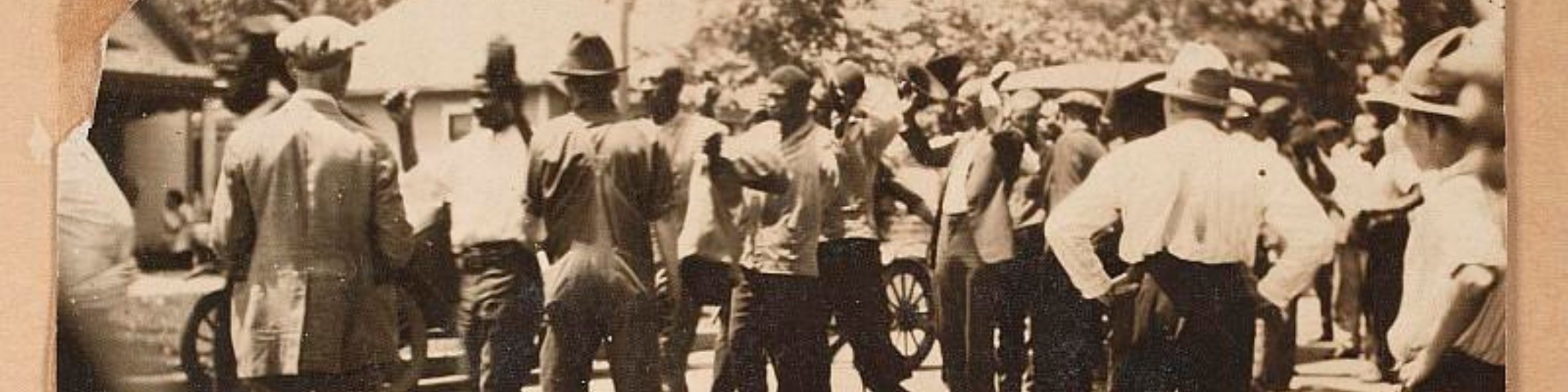
Criminalization does not begin with a crime
Most of us think criminalization begins after someone breaks a law. A person is arrested, charged, taken to court, or sent to jail. But that is already late in the process. Before any of those things happen, people have already decided who looks suspicious, who should be watched more closely, whose story sounds believable, and whose behavior needs an explanation.
Slave patrols were created to watch Black movement and stop enslaved people from traveling, gathering, or trying to reach freedom. After slavery, Black Codes made ordinary parts of life — such as being unemployed or standing in a public place — grounds for arrest when Black people did them. Convict leasing then sent many of those arrested people back into forced labor. Later came vagrancy laws, stop-and-frisk policies, and harsh drug sentences that again placed heavier watch and punishment on communities already labeled dangerous.
Exhibit · Record
How criminalization worked
Open any entry for who it named, what it authorized, and what replaced it.
1704 · Slave patrols
South Carolina, then across the South
Who it named
Any Black person found away from a plantation without a written pass
Who enforced it
Armed civilian patrols, drawn from the local white militia
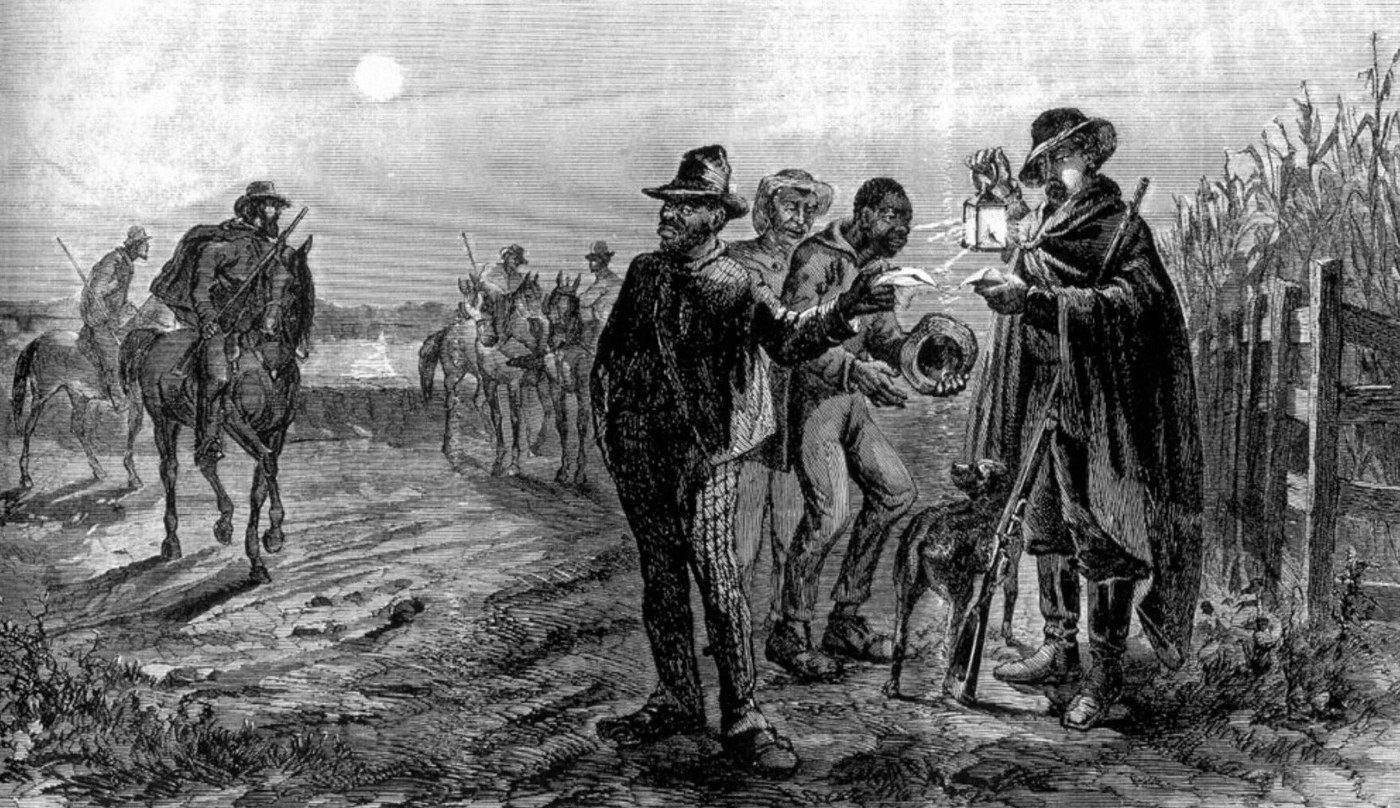
A patrol stops two men on a road at night and inspects their passes by lantern. The written pass is the instrument: without one, being outside was itself the offense.Nineteenth-century wood engraving. Provenance to be confirmed. Source · Each entry carries its own citation. Instruments from the historical record; Terry v. Ohio, 392 U.S. 1 (1968).
1865 · Black Codes
Mississippi and South Carolina first, then most of the former Confederacy
Who it named
Black people who could not produce written proof of employment
Who enforced it
County sheriffs and local courts
1866 · Vagrancy law and convict leasing
Across the South, under the Thirteenth Amendment’s own exception
Who it named
People convicted of vagrancy, loitering, or petty theft
Who enforced it
State penitentiaries, leasing the convicted to private industry
1920s · Suspicious person ordinances
Northern and Western cities during the Great Migration
Who it named
Anyone an officer judged unable to give a good account of themselves
Who enforced it
Municipal police departments
1968 · Stop and frisk
Nationwide, after Terry v. Ohio
Who it named
Anyone an officer suspected on less evidence than an arrest would require
Who enforced it
Municipal police departments
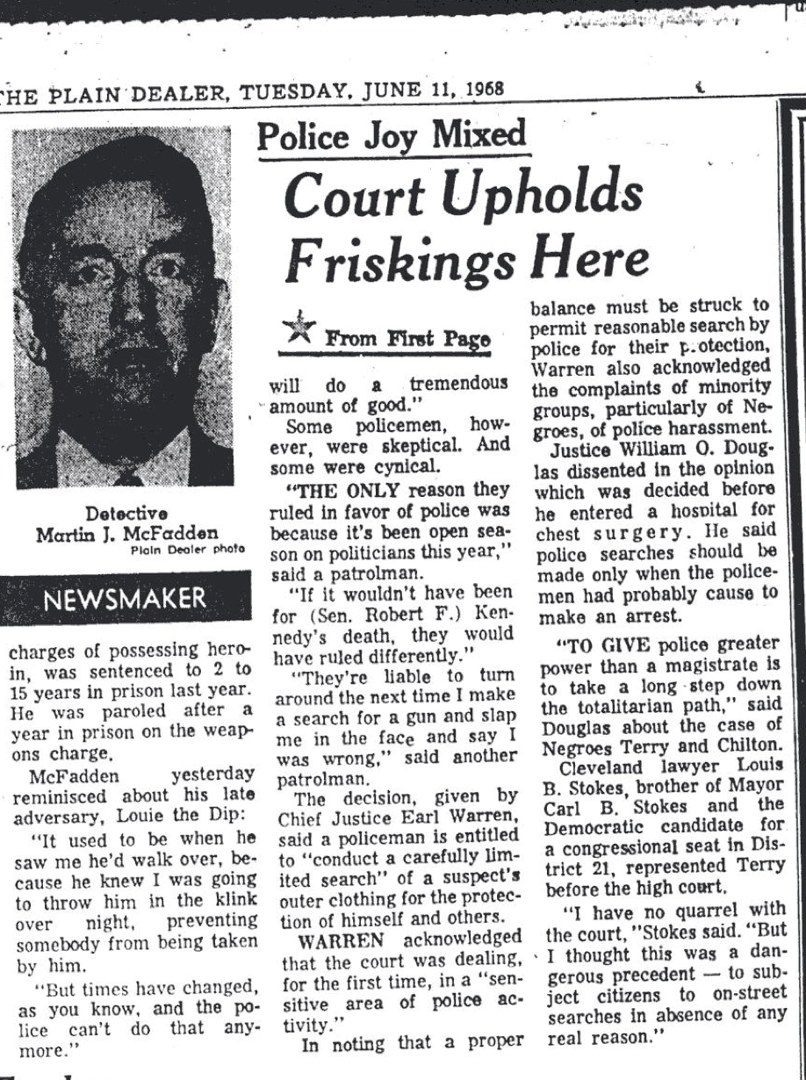
The Plain Dealer, Cleveland, 11 June 1968 — the morning after Terry v. Ohio was decided. The paper records Chief Justice Warren acknowledging the complaints of minority groups about police harassment in the same ruling that authorized the practice, and Justice Douglas dissenting that giving police more power than a magistrate was a step down a totalitarian path.The Plain Dealer, 11 June 1968. Reproduced for commentary and criticism. 1994 · Sentencing enhancements
Federal and state law
Who it named
People convicted under mandatory minimums and habitual-offender statutes
Who enforced it
Federal and state courts
Today · Mandated reporting
Every state, in every hospital
Who it named
Patients flagged at delivery, most often on a drug screen ordered without a stated rule
Who enforced it
Hospitals, and the child welfare agencies they report to
Instruments and dates from the historical record.
Public conversations about policing often center Black men, for clear reasons. But Black women and families can meet the same kind of scrutiny during pregnancy, birth, and early parenting. This can show up in who is tested for drug use, whose newborn is tested, who is reported to child protective services, or whose explanation is treated as less believable.
A national study estimated that 37% of all children in the United States are the subject of a child protective services investigation before their eighteenth birthday. Among Black children the estimate is 53%, against 23% of white children. That is a majority of Black children investigated at least once, and it is more than twice the white rate. So the question cannot only be whether one report or one test was allowed under policy. We also have to ask who is being tested and reported most often, what reasons are being used, and whether the same concern would lead to the same response for another family.
A healthcare worker may genuinely believe they’re protecting a baby, following hospital policy, or responding to a possible risk. Those are all reasonable things to want to do. But they don’t answer a different question: are the same concerns leading to the same decisions for every family?
The journalist Irin Carmon spent years following what this looks like from inside a family’s life. In Unbearable, she reports on Hali, jailed in Alabama under the state’s chemical endangerment law after a positive drug screen and left bleeding on a concrete floor while still recovering from birth. The law was written to protect children. What it produced was a postpartum woman in a cell.
A drug test may be appropriate in one situation and based on an assumption in another. A report to child protective services may protect a child in one case and unnecessarily pull another family into a stressful investigation with its own harmful impacts. The written policy may be exactly the same in both situations. What changes is how people interpret what they’re seeing, what they consider concerning enough to act on, and whether they would make that same decision if someone else were sitting in front of them. When the data consistently shows that Black families are being tested, reported, or investigated more often, it’s worth asking what might be contributing to that pattern.
This is one reason some Black families enter pregnancy and birth already carrying a certain amount of caution. They may wonder whether asking for help will bring support or unwanted scrutiny. They may wonder whether being honest about stress, housing, substance use, or mental health will lead to resources — or to consequences. Trust is difficult to build when people don’t know whether they’ll be met with understanding or suspicion.
This does not necessarily mean reporting rules should disappear. It means those rules have to be used with clear evidence and the same standards for everyone. We have to look at who is watched, who is believed, and who is reported — and change the process when the pattern shows that our choices are not fair.
Get new chapters and updates →
Sources 6 entries
- Kim, Hyunil, Christopher Wildeman, Melissa Jonson-Reid and Brett Drake. “Lifetime Prevalence of Investigating Child Maltreatment Among US Children.” American Journal of Public Health 107, no. 2 (2017).
- “Medical Professional Reports and Child Welfare System Infant Investigations: An Analysis of National Child Abuse and Neglect Data System Data.” Health Equity, September 2023. Investigation rates doubled from 13.1 to 27.1 per 1,000 infants between 2010 and 2019; in 2019, 1 in 18 Black, 1 in 31 Indigenous and 1 in 41 white infants.
- U.S. Government Accountability Office. Analysis of Civil Rights Data Collection school discipline data, 2024.
- Georgetown Law Center on Poverty and Inequality. Girlhood Interrupted: The Erasure of Black Girls’ Childhood. 2017.
- Terry v. Ohio, 392 U.S. 1 (1968). Earlier instruments from the historical record.
- Carmon, Irin. Unbearable: Five Women and the Perils of Pregnancy in America. Simon & Schuster, 2025.