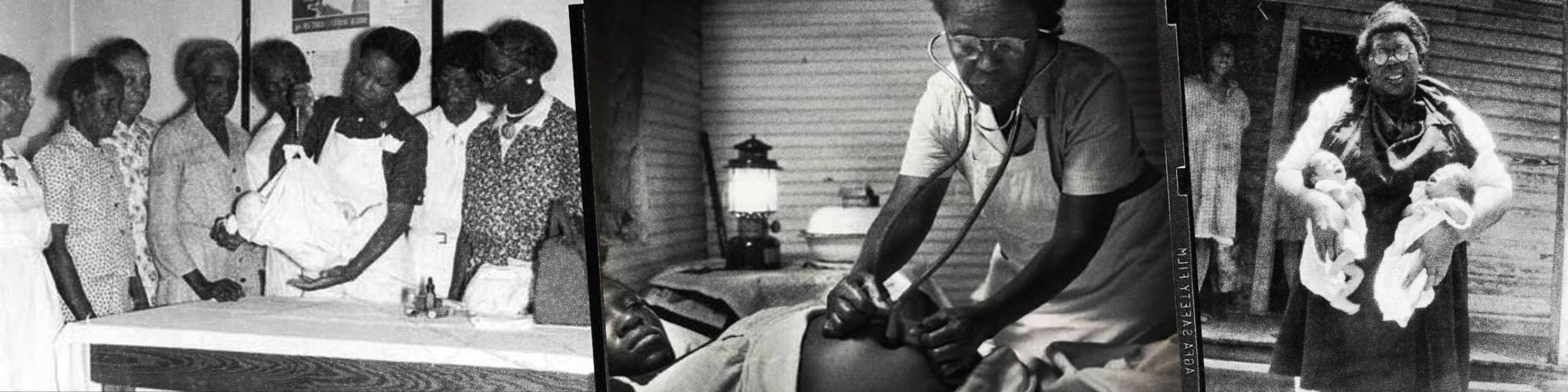
The history of Black midwifery
Black families are often thinking about birth well before labor starts — and, for many, before pregnancy. They may be thinking about how to speak up in a medical setting, where to find a provider they trust, or how to prepare for the chance that a concern will not be heard. Some are trying to build a care team that feels safe before they ever need one. The reasons for this reach back more than 400 years. They involve laws, medical practices, money, and choices made by real people about whose lives mattered and whose knowledge mattered.
Black midwifery is a helpful place to begin because it gives us a smaller view of a much larger story. It shows what happened when a group of skilled care providers held deep knowledge and trust in their communities, and when a growing medical system decided that their work stood in the way of its own growth.
Exhibit · Timeline
Six eras of Black midwifery
Step through each era, from African midwives before the transatlantic slave trade to the present.
01Pre-1600s
African midwives as community healers and spiritual guides
Before the transatlantic slave trade, midwifery across West African cultures was a respected profession. Midwives were healers, medical professionals, and spiritual leaders who blended herbal medicine, massage, and prayer with birth assistance. Birth was a communal event — midwives oversaw labor, postpartum recovery, fertility care, and child spacing.
Knowledge passed down through oral tradition and through apprenticeship with elder midwives. When African people were kidnapped and enslaved, they carried that knowledge to the Americas — and kept the tradition alive under brutal conditions.
021600s–1800s
The backbone of reproductive healthcare
Under American slavery, Black midwives were central to both enslaved and free communities. Enslaved midwives delivered Black and white babies alike — white households in the rural South relied on their expertise. They were birth attendants, healers, and community protectors, drawing on African herbal medicine and generational knowledge.
They helped enslaved women survive forced reproduction, exploited to grow the enslaved labor force. Some provided abortions as acts of resistance — refusing the forced birth of children into slavery.

Source · Margaret Charles Smith, Listen to Me Good (Ohio State, 1996); Onnie Lee Logan, Motherwit (Dutton, 1989); Shafia Monroe, The Role of the African American Midwife in the United States (ICTC, 2002); Abraham Flexner, Medical Education in the United States and Canada (Carnegie Foundation, 1910); Sheppard–Towner Maternity and Infancy Act, 1921.
Notable figure
Bridget "Biddy" Mason · 1818–1891
Enslaved as a midwife, she won her freedom in court, practiced midwifery in Los Angeles, and used her wealth as a landowner and philanthropist to open care for Black families.
Portrait of Biddy Mason, ca. 1870s · Wikimedia Commons · Public domain
031870s–1920s
Under attack by the medical establishment
After Emancipation, midwifery remained essential to newly freed communities with little access to white hospitals. By 1900, nearly half of all U.S. births were attended by midwives, with Black midwives dominating the rural South.
Then the medical profession moved to discredit and eliminate them. The 1910 Flexner Report shut down most Black medical schools, cutting Black physicians out of obstetrics. The 1921 Sheppard-Towner Act, framed as public-health reform, drove the criminalization of traditional midwifery. The AMA and white obstetricians cast midwives as "dirty" and "uneducated" — despite birth outcomes that bettered many hospitals.
041930s–1950s
The forced decline, and the rise of white midwifery
As the medical industry restricted and criminalized Black midwifery, white midwives reclaimed the profession under an institutional model. Restrictive licensing pushed many Black midwives out of practice, and hospital birth became the norm. Nurse-midwifery resurged through white-led medical programs.
Meanwhile, hospital segregation meant Black patients were mistreated in the very institutions that had banned Black midwives from practicing independently.
Notable figure
Margaret Charles Smith · 1906–2004
Took her midwife permit in Greene County, Alabama in 1949 and attended nearly three thousand births before the state pushed her out. She never lost a mother. Her oral history, Listen to Me Good, is one of the few first-person records of the work.
051960s–1980s
Midwifery and reproductive justice
As Black midwives were being erased, Black women organized to reclaim midwifery as a matter of reproductive justice. The 1965 passage of Medicare and Medicaid pushed births further into hospitals. In the 1970s, the Black Panther Party and Young Lords built community birth-justice programs addressing Black infant mortality. By 1977, the "Grand Midwives" of the South were beginning to be formally recognized.
Notable figure
Onnie Lee Logan · 1910–1995
Practised in Mobile County, Alabama from 1931 until 1984, when the state dismissed the last of its Black midwives. Her memoir, Motherwit, was published five years later.
061990s–Today
The Black midwifery renaissance
Black midwives, doulas, and reproductive-justice advocates are reclaiming midwifery as a life-saving intervention for Black families. Black-led birth centers and training programs revived the profession in the 1990s. In 2000, Jennie Joseph developed The JJ Way®, a patient-centered model that sharply reduced Black maternal mortality within her organization's outcomes.
The Black Mamas Matter Alliance emerged in 2018. The 2020 pandemic drove demand for home birth. In 2021, Congress introduced the Black Maternal Health Momnibus Act. Yet of the 400-plus birth centers across the country in 2024, only about 20 are owned or led by Black, Indigenous, or people-of-color midwives.
Black midwives cared for families across much of the American South for many generations. Some of their knowledge came from West and Central African traditions carried by people who were forced to this country. More was learned through hands-on practice and passed from one midwife to the next. They cared for Black and white families, including people who lived far from a doctor or were not welcome in a hospital. In many places, they attended most of the births.
One of those midwives was Mary Francis Hill Coley of Georgia. In 1952, the Georgia Department of Public Health worked with filmmaker George C. Stoney to document her work in a film called All My Babies. The film follows Coley as she cares for families, teaches younger midwives, and moves through her community with skill and confidence. Today, it remains one of the clearest records we have of Black midwifery in practice — and a reminder that they were highly knowledgeable professionals at a time when many public health campaigns were beginning to describe them as outdated or unsafe.
Mary Francis Hill Coley at work, filmed as a training film for midwives and later added to the National Film Registry. Coley delivered more than three thousand babies in and around Albany, Georgia. U.S. National Library of Medicine. Loaded from YouTube only when play is pressed. Watch on YouTube
The decline of Black midwifery was not simply the result of medical progress. Black midwives helped create the foundation of knowledge that nurses and doctors later built on. But as doctors, nurses, and hospitals gained more power, Black midwives were no longer treated as people to learn from or work beside. They were treated as competition.
Exhibit · Figure
Who attended Black births
Share of Black births attended by a midwife, 1930s and 2020.
Share of Black births attended by a midwife. In the 1930s, midwives — overwhelmingly Black grand midwives — attended roughly four in five Black births. Ninety years of licensing laws, hospital campaigns, and outright exclusion cut that to fewer than one in ten.
Source · Shafia Monroe, ICTC, 2002; Time, “The History That Explains Today’s Shortage of Black Midwives,” 29 February 2024.
New licensing rules made it harder for them to keep working. Public health campaigns described them as dirty, unsafe, or untrained. Doctor-led groups marketed hospital birth and physician care as the modern choice, even when many hospitals still would not serve Black patients. Over time, policy and public opinion took away much of the freedom Black midwives had to practice.
This pattern — power and influence being used to support one group while pushing another aside — will show up again in this exhibition. Beginning with Black midwifery helps us see it in a place that is directly tied to maternal health and to the care families receive today.
Exhibit · Figure
Who the midwives are now
Share of certified midwives today who are Black or African American.
8.7%
of certified midwives today are Black or African American — the workforce best positioned to close the Black maternal-mortality gap is one of the least diverse in health care.
- Midwives of color — 17.4%
- White — 82.6%
Source · American Midwifery Certification Board, demographic data; National Black Midwives Alliance.
Still being kept
The African Indigenous Midwifery Museum
In Ferguson, Missouri, Okunsola M. Amadou has built the first brick-and-mortar museum devoted entirely to midwifery — and, she notes, the only one founded by a Black midwife. It documents African diasporic midwifery from antiquity to the present through exhibits, artifacts, oral histories, and research archives, tracing sacred birth practices across Africa and the Diaspora.
The museum is home to the African Indigenous Midwifery Library & Research Institute, which chronicles the evolution of midwifery worldwide and is open to the public — to midwives and students, to obstetric providers and community birth workers, to policy makers, and to anyone who wants to know where this history comes from.
In May 2026 the American Alliance of Museums — the only organization representing the entire museum field — named Amadou one of eighteen honorees recognized for exemplary work, receiving a Nancy Hanks Memorial Award for Rising Stars as founding chief curator. She is Missouri’s first African American Certified Professional Midwife and its first Black registered CPM preceptor, and she founded the state’s first Black midwifery clinic and school.


The African Indigenous Midwifery Museum, Ferguson, Missouri. Photographs courtesy of Okunsola M. Amadou.
Get new chapters and updates →
Sources 25 entries
Books & articles
- Roberts, Dorothy. Killing the Black Body: Race, Reproduction, and the Meaning of Liberty. Vintage Books, 1997.
- Ross, Loretta J., et al. Radical Reproductive Justice: Foundations, Theory, Practice, Critique. Feminist Press, 2017.
- Davis, Angela. Women, Race, & Class. Vintage, 1983.
- Smith, Margaret Charles. Listen to Me Good: The Life Story of an Alabama Midwife. Ohio State University Press, 1996.
- Logan, Onnie Lee. Motherwit: An Alabama Midwife’s Story. Dutton, 1989.
- Monroe, Shafia. The Role of the African American Midwife in the United States. ICTC, 2002.
- Time. “The History That Explains Today’s Shortage of Black Midwives.” 29 February 2024.
- American Midwifery Certification Board, demographic data on certified nurse-midwives and certified midwives.
Historical & medical research
- Washington, Harriet A. Medical Apartheid. Doubleday, 2006.
- Centers for Disease Control and Prevention. Racial and Ethnic Disparities in Pregnancy-Related Deaths.
- Flexner, Abraham. Medical Education in the United States and Canada. Carnegie Foundation, 1910.
- Sheppard-Towner Maternity and Infancy Act, 1921. U.S. Congressional Record.
- National Black Midwives Alliance.
Documentaries & podcasts
- NPR / The New York Times. 1619: How the Bad Blood Started. 2019.
- ProPublica. “Nothing Protects Black Women from Dying in Pregnancy and Childbirth.” 2017.
- Death by Delivery. Dir. Nelufar Hedayat, Fusion TV, 2017.
- The American Experience: The Midwife. PBS, 1999.
- NATAL: A Docuseries About Having a Baby While Black. Martina Abrahams Ilunga and Gabrielle Horton, 2020.
- Stoney, George C., dir. All My Babies: A Midwife’s Own Story. Georgia Department of Public Health. Hosted by the U.S. National Library of Medicine, https://youtu.be/4qjzGG6ya9M.
Organizations & reports
- Black Mamas Matter Alliance.
- Commonsense Childbirth School of Midwifery.
- International Center for Traditional Childbearing.
- National Association to Advance Black Birth.
- Evidence-Based Birth: Racism + Maternal Health.
- American College of Nurse-Midwives: History of Midwifery in the U.S.