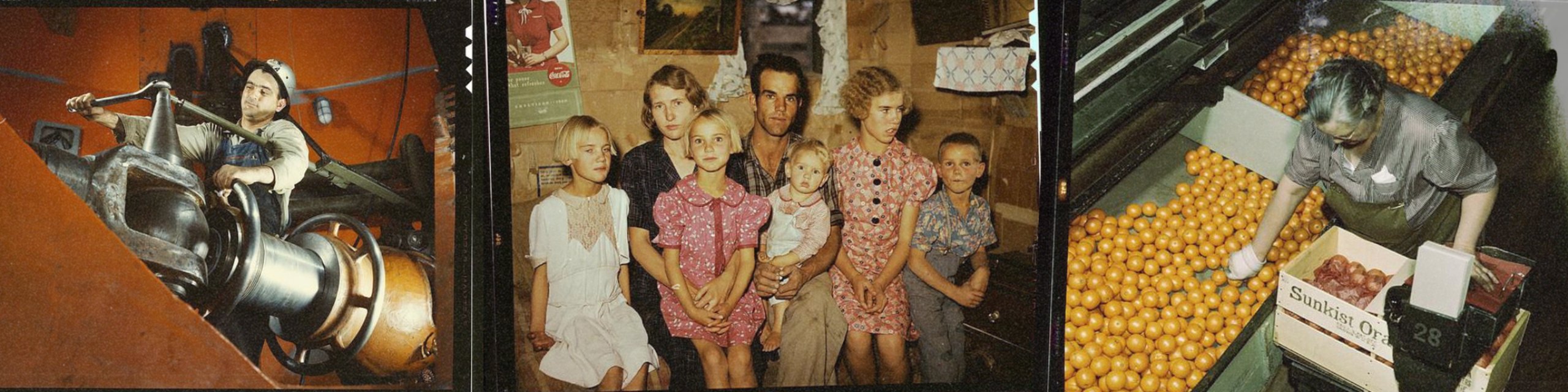
Why being white doesn't guarantee wealth or power
So race explains everything, then? That’s not what history shows us. There’s complexity here. Race has always mattered in America. And it has never been the only thing that mattered.
A person can experience real hardship while also benefiting from advantages they didn’t choose. A person can overcome extraordinary barriers and build wealth, education, or influence while still encountering obstacles tied to race. Those realities are happening all around us every day.
This is one reason it can be helpful to think about power as something that has many dimensions rather than a single source. Race is one of them. Wealth is another. Education, disability, immigration status, geography, sexuality, and gender all shape what opportunities are available to someone and what barriers they may encounter. These can all interact with each other in unique and complicated ways.
Exhibit · Interactive
Proximity to whiteness, power and wealth
Select any point in the field to see how the two measures combine.
skewed here Least
This shows how a system hands out advantage — not anyone’s worth, how hard they work, or how real their struggle is. Nobody is just two things on a chart. Gender, disability, sexuality, and immigration status shape where a person lands too. What you’re seeing here is only two of those forces, side by side. Tap anywhere in the field, or any marked spot, to read it.
Source · The field is the exhibition’s own construction, drawn from W.E.B. Du Bois, Black Reconstruction in America (Harcourt, Brace, 1935), and David Roediger, The Wages of Whiteness (Verso, 1991). It is illustrative, not a measured scale.
One of the reasons this matters so much in maternal health is that race and class don’t always influence the same part of a person’s experience.
Money often shapes the choices available to a family. It can affect where someone lives, what insurance they carry, whether they can take time away from work, hire a doula, travel to another hospital, or pay for specialized care. Those resources matter because they create options.
Race can shape something different. It can still influence what happens after those choices have already been made. It can affect whether someone’s concerns are believed, whether they’re seen as knowledgeable or difficult, whether they’re given the benefit of the doubt, or whether a symptom is treated as urgent.
This helps explain why improving access is so important while also recognizing that access alone doesn’t solve every disparity. Between 2007 and 2016, Black women who had finished college died of pregnancy-related causes at a rate of 40.2 deaths per 100,000 births. White women who had not finished high school died at a rate of 25.0 per 100,000 births. In other words, completing college did not erase the disparity.
Does that mean education or wealth don’t matter? Again, no. But it means that race can continue shaping a person’s experience even after many other barriers have been removed.
Exhibit · Figure
What education buys, and who it buys it for
Pregnancy-related deaths per 100,000 live births, by the level of schooling completed. United States, 2007–2016.
Read down the white bars and education does what it is supposed to do: the risk falls by more than two thirds, from 25.0 to 7.8. Read down the Black bars and it barely moves. Whatever a diploma is protecting against, it is not protecting against this.
Petersen EE, Davis NL, Goodman D, et al. “Racial/Ethnic Disparities in Pregnancy-Related Deaths — United States, 2007–2016.” MMWR 2019;68:762–765. CDC Pregnancy Mortality Surveillance System.
Serena Williams’ story is often part of this conversation because it removes many of the explanations people typically reach for first. She had fame, extraordinary financial resources, private insurance, access to excellent medical care, and years of experience understanding her own body as one of the world’s most accomplished athletes. She also knew her medical history well. After giving birth, she recognized symptoms that matched blood clots she had experienced before and repeatedly asked to be evaluated. She still had to advocate forcefully — and push through resistance — before receiving the testing that confirmed a pulmonary embolism.
In recent years, other well-known Black women, including Beyoncé, Allyson Felix, Tatyana Ali, and others, have also spoken publicly about concerning pregnancy and postpartum complications and healthcare interactions. Their experiences don’t represent every Black family. They do remind us that wealth, education, influence, and access to excellent healthcare don’t always protect Black women from being dismissed, underestimated, or experiencing serious harm.
This isn’t a competition between race and class. Poverty has profound effects on pregnancy, birth, and postpartum health. A white family living in a rural community may lose access to obstetric care because the nearest birth unit closes. A family of any race may struggle because they can’t afford reliable transportation, childcare, healthy food, or unpaid time away from work.
Those realities matter, and addressing them would improve outcomes for countless families.
The point is to understand that different problems often require different solutions. Some disparities may be driven primarily by poverty. Others may persist even after many economic barriers have been removed. If we want to improve maternal health, we have to become better at recognizing which forces are at work — and responding to them in the best way to address that part.
Get new chapters and updates →
Sources 3 entries
- Du Bois, W.E.B. Black Reconstruction in America, 1860–1880. Harcourt, Brace, 1935 — where the “public and psychological wage” of whiteness is described.
- Roediger, David R. The Wages of Whiteness: Race and the Making of the American Working Class. Verso, 1991.
- Petersen, Emily E., Nicole L. Davis, David Goodman, et al. “Racial/Ethnic Disparities in Pregnancy-Related Deaths — United States, 2007–2016.” MMWR Morbidity and Mortality Weekly Report 68, no. 35 (September 6, 2019): 762–765.